how to draw 3d vectors
7. Vectors in 3-D Space
We saw earlier how to stand for two-dimensional vectors on the ten-y airplane.
Now nosotros extend the thought to represent 3-dimensional vectors using the x-y-z axes. (Run across The iii-dimensional Co-ordinate System for groundwork on this).
Example
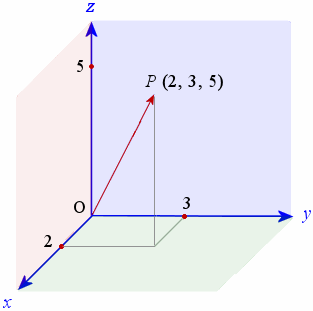
The vector OP has initial point at the origin O (0, 0, 0) and terminal signal at P (2, iii, 5). We can draw the vector OP as follows:
Magnitude of a three-Dimensional Vector
We saw earlier that the distance between 2 points in three-dimensional space is
`"altitude"\ AB = ` `sqrt ((x_2-x_1)^2+ (y_2-y_1)^two+ (z_2-z_1)^two)`
For the vector OP above, the magnitude of the vector is given by:
`| OP | = sqrt(two^two+ three^two+ five^2) = half-dozen.xvi\ "units" `
Adding 3-dimensional Vectors
Earlier we saw how to add 2-dimensional vectors. We now extend the idea for three-dimensional vectors.
Nosotros but add the i components together, then the j components and finally, the thousand components.
Case one
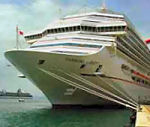
Two anchors are property a send in place and their forces acting on the ship are represented by vectors A and B as follows:
A = 2i + vj − 4k and B = −2i − threej − fiveone thousand
If we were to supervene upon the ii anchors with 1 single anchor, what vector represents that single vector?
Respond
Dot Product of 3-dimensional Vectors
To notice the dot production (or scalar product) of 3-dimensional vectors, we just extend the ideas from the dot product in 2 dimensions that we met earlier.
Instance two - Dot Production Using Magnitude and Bending
Notice the dot product of the vectors P and Q given that the angle between the two vectors is 35° and
| P | = 25 unit of measurements and | Q | = 4 units
Respond
Example 3 - Dot Product if Vectors are Multiples of Unit Vectors
Detect the dot product of the vectors A and B (these come from our anchor instance higher up):
A = 2i + 5j − 4k and B = −2i − 3j − 5k
Answer
Management Cosines
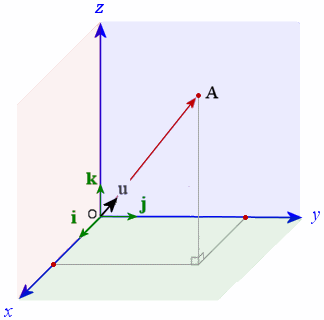
Suppose we have a vector OA with initial point at the origin and terminal indicate at A.
Suppose too that we have a unit vector in the same direction as OA. (Get here for a reminder on unit vectors).
Allow our unit vector exist:
u = u one i + u 2 j + u 3 g
On the graph, u is the unit vector (in black) pointing in the same direction every bit vector OA, and i, j, and k (the unit of measurement vectors in the x-, y- and z-directions respectively) are marked in green.
We now zoom in on the vector u, and change orientation slightly, equally follows:
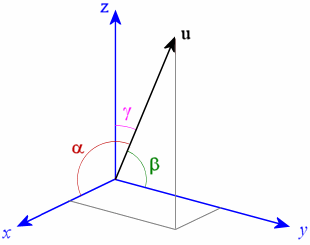
Now, if in the diagram above,
α is the angle between u and the x-axis (in dark ruby-red),
β is the angle between u and the y-axis (in green) and
γ is the angle between u and the z-axis (in pink),
then we can use the scalar product and write:
u ane
= u • i
= 1 × 1 × cos α
= cos α
u ii
= u• j
= i × 1 × cos β
= cos β
u 3
= u • chiliad
= 1 × one × cos γ
= cos γ
So we tin can write our unit of measurement vector u every bit:
u = cos α i + cos β j + cos γ k
These three cosines are called the management cosines.
Angle Betwixt three-Dimensional Vectors
Earlier, we saw how to discover the bending between 2-dimensional vectors. We utilise the same formula for three-dimensional vectors:
`theta=arccos((P * Q)/(|P||Q|))`
Case 4
Find the bending between the vectors P = fouri + 0j + 7thou and Q = -2i + j + 3k .
Reply
Practice
Detect the angle betwixt the vectors P = 3i + 4j − 7k and Q = -2i + j + 3yard .
Reply
Application
We have a cube ABCO PQRS which has a string along the cube's diagonal B to South and another along the other diagonal C to P
What is the angle between the 2 strings?
Respond
Problem Solver
Need assistance solving a dissimilar Graphing problem? Endeavour the Problem Solver.
Disclaimer: IntMath.com does not guarantee the accuracy of results. Problem Solver provided by Mathway.
mooreationestreen.blogspot.com
Source: https://www.intmath.com/vectors/7-vectors-in-3d-space.php
0 Response to "how to draw 3d vectors"
Enregistrer un commentaire